A company can buy every website certificate from a reputable supplier and still be exposed when a different supplier’s signing key is compromised. The reason is on the other side of the connection. A device calling a service decides which authorities may vouch for that service’s identity. Its list can include issuers the company has never paid. Asking procurement whether the company buys certificates from the compromised issuer answers a useful question about its servers. It leaves open a more urgent question about its clients.
The CISO should direct the response around critical connections. For each one, identify who controls the client’s trust decision, what would make it reject the compromised signing path, and whether it can still reach its intended destination afterward. Those answers give the business owner a basis for choosing between continued operation, a temporary restriction and a planned interruption.
One incident, several clocks
On October 20, Google’s Chrome and Android security teams described the compromise of signing keys associated with eight eMudhra intermediate certificate authorities. An intermediate authority is an issuer trusted through a higher authority, called a root. Weak key generation meant someone else could produce a certificate that appeared to authenticate a website they did not control. That creates an opportunity for impersonation where the client still accepts that signing path. It does not establish that anyone intercepted a particular connection.
In Mozilla’s October 20 disclosure, Dennis Jackson explained that Firefox had distributed a block on October 17 without requiring a browser restart. Google described blocking the affected public keys in Chrome and separately removing a root for consumers that did not receive the same block list. The important distinction for an enterprise is who delivers each change. A browser team can act quickly for the clients it reaches. Its action says little about a meeting-room appliance, a service running in a container or a supplier that sends data into the enterprise.
A concrete example came on October 30, when Neat updated its advisory. Neat reported that its stable device update had rolled out and that fixes for certain outbound connections from two cloud services were still in progress. Its own device-management services did not use eMudhra-issued certificates. The relevant exposure was that an unupdated device could accept a forged certificate for one of those services if an attacker also had the necessary network position. Neat reported no evidence of exploitation. These are the supplier’s findings about its products, not evidence about another fleet.
Start with what crosses the connection
Consider a hypothetical conference device that connects through a company-managed proxy. The network team operates the proxy, workplace technology owns the rooms, and a supplier maintains the device software. All three can report accurately and still miss the outage. The network team sees a valid, unexpired proxy certificate. The device team sees the supplier’s security update installed. A meeting fails because the updated device no longer accepts the authority behind the proxy certificate. Neither team’s dashboard had asked whether that pair would still connect.
Give that connection a named owner for the duration of the change. Have the owner draw one arrow from the device to the proxy and annotate it with the certificate the device actually sees, the authority it accepts, and the business function lost if verification fails. A second arrow is necessary if a supplier sends data back to the company: the supplier is then the client, and the company’s endpoint is the destination. The people who can change the first connection may have no control over the second.
Start with connections carrying credentials, sensitive records or commands that change a business system. For each, separate what the team observed from what it learned from the supplier. An on-device check might establish how a particular model behaves. A vendor notice might establish which software channel contains a fix. If the service runs entirely in the supplier’s cloud, the customer may only be able to verify delivery at its own endpoint. Keep that distinction in the incident record; it tells the CISO which uncertainty the enterprise can resolve itself.
Require two results from the same kind of client
Original LXSGRP editorial vector artwork
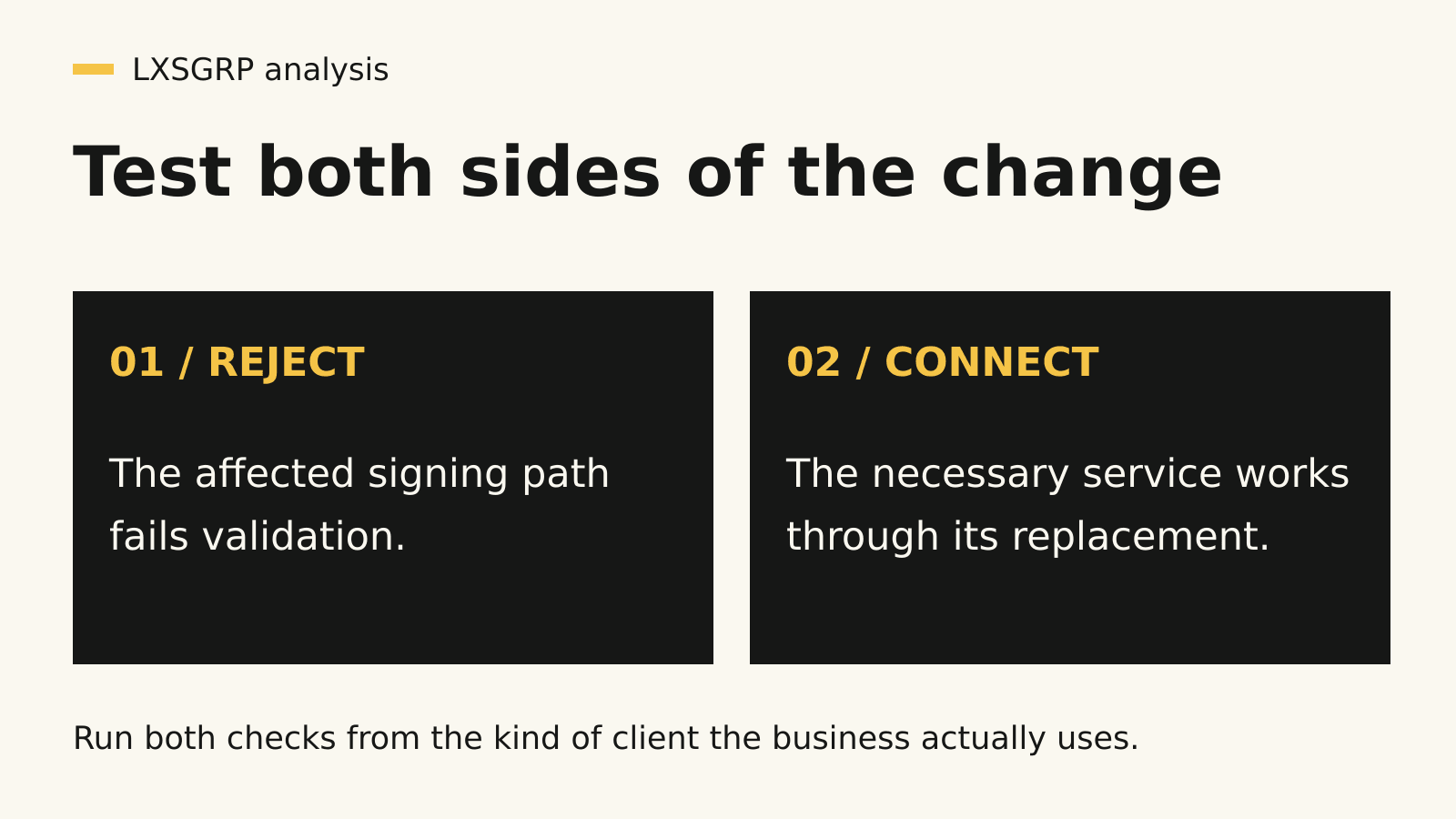
In a controlled environment, have the platform team establish that the client rejects the affected path under the intended policy. Use an approved test endpoint or the supplier’s documented validation method. Record what failed: a certificate rejection is useful evidence; a network timeout is not. Then connect to the legitimate destination with its replacement certificate and complete an ordinary business operation. In the room example, that means using the device through the proxy to perform the relevant meeting function. Loading a page on an administrator’s laptop tests a different client.
The results support different decisions. If both paths succeed, service is available but the protection has not been demonstrated. If both fail, the team has no basis for reopening the service or declaring the trust control effective; even a disconnected cable could produce that result. If only the intended service succeeds and the other path fails for the expected reason, the owner has evidence for expanding the rollout to comparable clients. Differences in software channel, proxy configuration or trust policy are reasons to test another group before treating the result as representative.
Choose the interruption the business can manage
Neat’s advisory identifies a real cost of broad distrust: devices that remove the affected roots may also lose access to legitimate services using certificates issued under them. Where the enterprise owns the destination, replacing its certificate and checking the resulting connection can preserve service. Where another party owns it, the CISO cannot promise that party’s timetable. Ask for a replacement plan and decide what can safely operate while waiting. Disabling certificate verification would defeat the protection the change was meant to supply.
The better interim choice depends on the business function. Pausing an optional outbound recording transfer may be acceptable if the owner can account for what is retained and what must later be delivered. Interrupting an essential communications service may require an independently verified alternate route first. For either decision, name the owner, affected clients, data at risk, temporary restriction and time of the next decision. A supplier’s estimated completion date can set a review point. It cannot establish that the work has finished.
At the next incident review, ask one service owner to bring the two test results for one important connection. Where the supplier controls the client, ask instead for the supplier’s evidence, the consequence the enterprise can observe and the remaining gap. That small exercise will expose a missing owner or an untested dependency while the team can still choose its response.
For discussion with peers: Which critical connection could your company lose by withdrawing trust tomorrow, and who has the authority to replace its certificate or authorize an alternate route?